2026 National Charter School Law Rankings & Scorecard
Florida holds the nation’s top spot for a third consecutive year — but this year’s real story is movement. Iowa rocketed from #11 to the top ten, and Ohio jumped nine spots on stronger enforcement of laws already on the books.
Only three states earned an A or A-, and just 40% of states with charter laws scored a B- or better — proof that most states still have real work to do to give families access to great public charter schools.
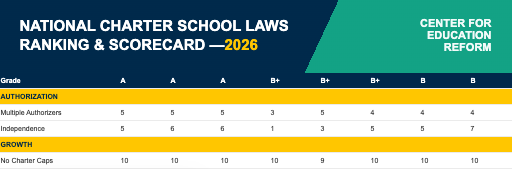
Dive Deeper Into The 2026 Rankings
“These rankings don’t measure intent — they measure what the written law actually produces.”
— Jeanne Allen, Founder & CEO, Center for Education Reform
Since 1996, CER has studied charter schools and their impact, environment, and practice, and made recommendations for how to improve each state’s law. The score is based on whether the law allows for the freedom and flexibility that lets parents, teachers, and the public build vibrant, successful charter schools — without undue interference from flawed state regulators, and with equitable funding and parents in the driver’s seat.
Read our guide that breaks down our 2026 evaluations of charter laws for each state.
An Introduction to Charter School Laws
Understanding State Charter School Laws: The Building Blocks of Choice
Charter schools, publicly funded but independently operated, owe their existence to state charter school laws. Currently, 47 states and the District of Columbia have enacted these crucial pieces of legislation. These laws, typically initiated and passed at the local or state level, lay the groundwork for the creation and operation of charter schools within their borders.
Why State Laws Matter:
The specifics of a state’s charter school law have a profound impact on the landscape of charter schools within that state. Strong, well-crafted laws, as highlighted by CER, tend to foster a thriving environment for high-quality charter schools, ultimately expanding educational options for families.
Key Elements of Effective Charter School Laws:
In essence, state charter school laws provide the framework that determines the opportunities and challenges for charter schools, ultimately shaping the educational choices available to families and the potential for innovation within the public education system.
No Limits on Growth
The most effective laws do not cap the number of charter schools allowed to operate or the number of students who can enroll. This encourages the development of diverse school options to meet varying student needs.
Diverse School Types and Applicants
Strong laws enable a wide range of groups to apply to open various types of charter schools (new schools, conversions of existing public schools, online programs, etc.), increasing parental choice.
Multiple Independent Authorizers
Instead of relying on a single entity (like the local school board) for approval, the best laws permit multiple independent organizations to authorize charter schools. This creates more pathways for quality schools to open and can include a fair appeals process for denied applications. Independent authorizers prevent potential conflicts of interest and foster a more diverse and innovative charter school sector.
Operational and Legal Autonomy (Waivers)
Effective laws grant charter schools significant freedom from many traditional school district regulations (excluding fundamental civil rights). This autonomy allows charter schools to innovate in curriculum, staffing, scheduling, and other areas, leading to unique educational models.
Equitable and Full Funding with Fiscal Autonomy
Charter schools, as public schools, should receive the same level of per-pupil funding as traditional public schools, without unwarranted deductions for administrative costs. Furthermore, they need control over their own finances to manage resources effectively and implement their educational vision.
What does a strong charter law look like?
Learn from CER’s 30 years of experience navigating charter school legislation in our seminal publications and research.

Charter Authorizing: The Truth about State Commissions
State charter school law debates have taken a dicey turn, necessitating a reevaluation by lawmakers and advocates.

The Essential Guide to Charter School Lawmaking: Model Legislation for States
CER’s roadmap for charter school law focuses on Independent and Multiple Authorizers, Number of Schools Allowed, Operations, and Quality. This framework, developed from 20 years of experience, reflects effective and ineffective policies.
1.
The existence of independent and/or multiple authorizers2.
The number of schools allowed and state caps3.
Operational and fiscal autonomy4.
Equitable funding
HERE’S WHY WE FIGHT FOR CHARTER SCHOOLS
Award-winning charter schools recognized for their sustainability, transformational impact, outstanding performance, and permissionless models are showcased below.













Charter schools are popular and innovative. They are also effective. But charter school success depends on the policy environments in which charter schools operate. Some state laws and regulations encourage diversity and innovation in the charter sector by providing multiple authorizers to support charter schools and allowing charters real operational autonomy. As Michael Q. McShane has pointed out, where diversity exists, charter schools have the opportunity to innovate.
Too many states, however, hamper charter schools with weak laws and needless regulations. These make it difficult to distinguish charters from their district counterparts.
Weak charter school laws have proven that when we apply the same old rules to district and charter schools, we get more of the same. Overregulation and underfunding force charters to behave as district schools by another name. Wouldn’t it make more sense to allow charters the room to innovate and succeed so that they could, in turn, help district schools subvert the status quo?
Since 1996 CER has researched, analyzed and ranked state charter school laws in an attempt to demonstrate how weak charter school laws create weak charter schools. These findings consider not only the content of each law, but also how the law impacts charter schools on the ground: How robust is the charter sector in each state? How diverse are the schools? To what extent do burdensome regulations prevent charters from doing anything meaningfully different?
Also From CER:
Charting a New Course: The Case for Freedom, Flexibility & Opportunity Through Charter Schools
Twenty-five years into the charter school debate revealed a divide among advocates — the system-centered vs the parent-centered. The conversations in this report changed the course for charter schooling.

Just the Facts: Success, Innovation, and Opportunity in Charter Schools
Released for National School Choice Week, offering a history of the 25-year-old charter school movement while addressing the myths that exist about the national charter school landscape. It debunks charter school misinformation with the most valid and reliable data.

The New Opportunity Agenda: A Movement at Risk - A Manifesto
This 2016 report was a clarion call for advocates and citizens everywhere to refocus our collective energies to arrest the decline of a failing education system that has international implications.